
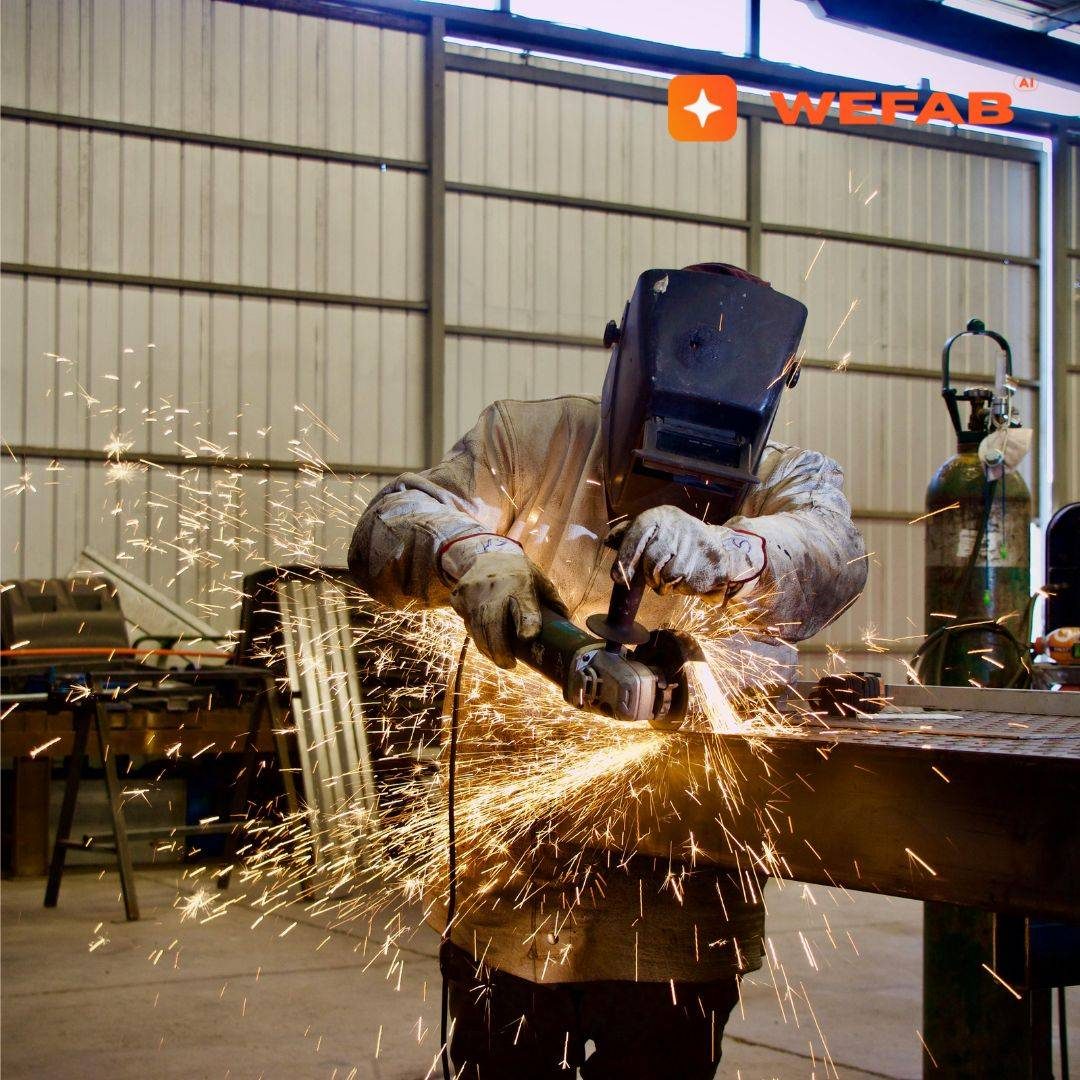
Shielded metal arc welding (SMAW) is an arc welding process that uses a consumable electrode covered with flux to lay the weld. Renowned for its dependability and simplicity, SMAW remains a leading choice for bonding steel and iron in construction, repair, and heavy fabrication.
It’s a process that performs admirably indoors or outdoors, including wild, windy weather. SMAW equipment is basic, doesn’t require gas bottles, and welds through a wide range of metals of varied thickness.
With low setup costs and simple upkeep, lots of factories and field crews use SMAW for structural, pipelines, and heavy equipment. Below, we discuss SMAW’s stages, advantages, and optimal applications.
What Is Shielded Metal Arc Welding?
Shielded metal arc welding (SMAW), also known as stick welding, is notable for its simplicity and adaptability. It utilizes a coated flux consumable welding electrode that protects the weld from the air, stabilizes the welding arc, and allows for a tough, fused metal bond. This technique remains a popular welding process in construction, repair, and industrial manufacturing scenarios, where portability and dependability count.
The machinery involved in the SMAW process is simple—a step-down transformer, occasionally with a rectifier for DC—and electrodes in set lengths, either 35 or 45 cm. Swapping electrodes is manual, so a welder’s pace and skill get involved, particularly for thinner materials.
The manual metal arc welding technique begins by gently tapping the electrode to the metal, spurring an arc that melts the rod and base metal. The flux coating vaporizes, creating a shield that keeps out oxygen and humidity. This simple step is key: it lets welders work outside, in tight corners, or on-site with minimal gear.
SMAW covers metals spanning carbon steel to iron and nickel alloys, and works even when surfaces aren’t clean—rust, paint or schmutz rarely prevent the weld from taking. SMAW is prized for its cost-effectiveness and robustness. It requires minimal maintenance and controls, which means it’s simple to train new operators on, and a go-to for field repairs or emergency fixes.
It’s more gradual than automatic welding, and the necessity to exchange electrodes caps efficiency for large production runs. Weld quality is dependent on operator skill, particularly with thinner metals (seldom below 1.5 mm). For startups and mid-sized firms, the trade-off is clear: SMAW cuts equipment costs and boosts agility but asks for skilled hands.
|
Feature |
SMAW |
Alternatives (e.g., MIG, TIG) |
|---|---|---|
|
Equipment cost |
Low |
Moderate to high |
|
Portability |
High |
Low to moderate |
|
Material versatility |
Wide |
Wide |
|
Skill required |
Moderate to high |
Moderate to high |
|
Automation potential |
Low |
High (MIG, TIG) |
|
Speed |
Moderate |
High (MIG), Low (TIG) |
|
Weld quality variability |
High (operator-driven) |
Lower (automated processes) |
For newbies and pros alike, conquering SMAW unlocks a plethora of real-world opportunities. Its ease, portability, and versatility keep it at the heart of contemporary fabrication and maintenance, making it a reliable choice in many welding applications.
Why Your Welds Are Cracking
Cracks in shielded metal arc welding can lead to downtime, repairs, and increased risks in mission-critical uses. The primary factors contributing to these cracks are associated with the manual metal arc welding process, design, material, and environment. Understanding these culprits and their warning signs is essential for preventing cracking before it leads to failure, especially when pursuing innovation and sustainability in sectors like robotics or climate tech.
Hydrogen Embrittlement
Hydrogen atoms can become entrapped in the weld during arc welding. This is typical with wet rods or in high humidity areas. Once inside, hydrogen can embrittle the weld. These cracks typically arise immediately after the weld cools, particularly below 93°C, but occasionally hours later.
Cracks are probable in the initial weld pass, where stress and hydrogen concentration are at their peak. Three things make hydrogen cracking worse: hydrogen in the weld, a hard and brittle microstructure like martensite, and high stress. Underbead cracks are the tell tale sign.
Cracks propagate quickly in steels with yield strengths greater than 620 MPa. Some very easy steps—preheating, drying electrodes and picking the right filler—will cut down hydrogen in the weld. For steels, low-hydrogen rods and dry parts assist.
Residual Stress
Residual stress is the leftover tension in the weld and base metal after it cools. Rapid cooling or joint restraint can capture this stress. It frequently makes an appearance as longitudinal cracks, initiating out from imperfections such as slag inclusions.
The weld root is stretched as additional layers are laid, leaving it susceptible to cracks. Stress relief by means of slow cooling or post-weld heat treatment helps release these. Joint design counts as well–nice fit-up and minimal restraint reduce danger.
Poor Design
Bad joint design can create stress-concentrating sharp corners or uneven welds. If components aren’t aligned or supported, it can cause cracks at weak points. In load-bearing equipment, a compromised seam or thin plates won’t last.
Reviews prior to welding capture these problems early. Even small fixes, such as adding fillets or backing bars, disperse stress and prevent cracking.
Material Mismatch
If base and filler metals don’t match, welds can crack as they cool. Metallurgical mismatch implies different shrink rates or strengths, which causes stress at the joint. Incompatible materials can create brittle zones that crack under load.
Match your filler to your base metal and check for compatibility — it keeps welds sound! Check specs and test materials prior to welding.
Are Weld Cracks Slowing Down Your SMAW Projects?
Optimize with expert techniques and design reviews, reducing cracks, ensuring durability, and improving weld quality for reliable outcomes.
Submit Your Project Today to Enhance Welds!
How to Prevent Weld Cracks
How to prevent weld cracks is critical for achieving safety, reliability, and cost goals in cutting-edge manufacturing. The dangers of cracking can be minimized by an arsenal of battle-tested strategies, all grounded in pragmatic process control and continuous experimentation.
For procurement managers and technical leads looking to optimize production, these steps provide tangible improvements in weld quality, velocity, and visibility.
- Clean and prepare surfaces before welding.
- Use proper joint design and fit-up.
- Preheat materials as required.
- Inspect materials for defects.
- Maintain stable arc and control travel speed.
- Choose correct electrode angles and manipulation.
- Monitor heat input and adjust welding parameters.
- Use post-weld heat treatment and non-destructive testing.
- Control cooling rates and finish weld surfaces.
Proper Preparation
Surface cleanliness is the first defense against weld cracks. Dirt, oil, rust, and moisture introduce contaminants that compromise fusion and lead to porosity or cold cracking. Cleaning the base metal with wire brushes or solvents removes these risks.
Joint design is another key factor: a well-designed joint with proper fit-up, angle, and gap supports complete fusion and bead shape, reducing the chance of bead shape cracking or centerline cracks.
For high-strength steels and thick sections, preheating to 100–200°C lowers thermal gradients, slows cooling, and helps prevent hydrogen-induced cracks. Before starting, all materials should be visually inspected for laminations or surface flaws.
Defective base metal can undermine even the best processes, so replacement is often the best solution.
Correct Technique
A stable arc is critical for controlling bead shape and minimizing undercut or overlap. They should concentrate on maintaining a steady arc length – usually 2–3 mm.
Arc voltage helps, too—a slight drop of 1 to 1.5 volts can enhance bead contour and steer clear of cracking. Travel speed and electrode angle should be matched to joint geometry and position, as moving too fast or slow raises the risk for cracks and undercut.
Regular electrode movement — such as weaving for wide joints — controls metal deposition and maintains a convex bead profile. Expert hands and continuous education go a long way — there are few protections like practice to combat process drift and flaws.
Heat Control
Heat input control is at the heart of SMAW. Overheating the weld zone induces grain growth and stress, while insufficient heat can render the joint brittle.
Amperage, voltage, and travel speed all impact heat distributed through the weld. Preheating and interpass temperature control (generally between 100–250°C for medium-carbon steels) prevent thermal shock and mitigate hardness spikes.
Monitoring with infrared thermometers or thermocouples ensures that the weld remains within the right temperature range, minimizing thermal stress and cracking risk.
Post-Weld Treatment
Post-weld heat treatment (PWHT) is applied to release residual stresses, most often in pressure vessels or thick sections. Slowing the cooling rate—typically by applying insulating blankets—avoids the fast contraction which cracks the weld.
Visual inspections and non-destructive testing, like ultrasonic or dye penetrant, spot secret defects before they become failures. Grinding or brushing the weld surface prevents stress risers and ensures quality.
Beyond Cracks: Manufacturing Weld Issues
SMAW, or stick, is a pillar of manufacturing. It’s based on fusion welding—the use of an electric arc to melt joint faces, fill gaps with molten metal and fuse parts as it cools. Weld quality issues extend well beyond cracks.
Porosity, undercutting, lack of fusion, spatter — all of these issues can sabotage the quality and aesthetics of your welds. Each has distinct causes and implications, which is why early identification and continual process improvement are crucial for dependable, scalable manufacturing.
Porosity
Common causes of porosity:
-
Base metals contaminated (oil, rust, paint).
-
Wet or poorly stored electrodes.
-
Insufficient shielding from atmospheric gases.
-
Too long of an arc.
-
Wrong welding current.
Porosity occurs when gas bubbles become entrapped in the solidifying weld pool. Contaminants, moisture and bad gas shielding are the main instigators.
To avoid porosity, maintain workpieces and electrodes clean and dry, employ the correct arc length and current, and store electrodes as per manufacturer recommendations. Routine inspection—both visual and radiographic—goes a long way toward detecting porosity before it contaminates finished products.
Undercutting
Prevention checklist:
-
Decrease travel speed.
-
Adjust electrode angle.
-
Lower weld current.
-
Utilize weaving.
Undercutting is when the weld eats into the base metal’s edge, leaving a groove. Fast travel speed, incorrect angle, or excessive current are common culprits.
Tweaking these variables keeps it at bay. Careful inspection — including dye penetrant or ultrasonic — makes sure undercutting doesn’t slip through.
Lack of Fusion
Lack of fusion is when the weld metal does not bond to the base metal or previous weld passes. This compromises integrity and can cause failure under load.
A controlled technique, joint prep, and proper heat input are critical. Common causes are dirty joints, low amperage, or bad electrode manipulation.
Experienced welders are instrumental in achieving complete fusion by monitoring arc stability and fine-tuning parameters on the fly.
Spatter
Spatter consists of bits of molten metal flung around the weld area, which give the weld a rough appearance and need additional cleaning. Reasons for spatter may include high current, incorrect polarity, or incorrect electrode type.
Its prevention is based on finely tuning the amperage, using the right electrodes, and keeping a steady hand. Cleaning up spatter helps the finished product look good and function properly.
Struggling with Weld Quality in SMAW Applications?
Improve your process with heat control, material selection, and real-time monitoring, delivering strong, defect-free welds for your projects.
Explore Solutions Today to Elevate Your Welding!
Mastering SMAW for Quality
Generating dependable outcomes with the shielded metal arc welding process (SMAW) combines hands-on expertise with a solid knowledge of process parameters. Top-notch welds are a function of understanding material behavior, equipment temperament, and how minor adjustments can result in quantifiable leaps forward or back. Lifelong learning, obsessive detail, and a devotion to safety all help make the manual metal arc welding into a repeatable, scalable process to facilitate innovation.
Electrode Choice
The electrode is an important parameter in SMAW. It’s not just about choosing the right electrode to match your base metals, but controlling bead profile, penetration and weld strength. Welders must be able to read and understand classification codes such as E6010 or E7018.
For instance, E6010 rods perform best with deep penetration and DCEP (direct current electrode positive), resulting in quicker rod consumption—great for root passes but not necessarily for every position or material. Understanding these codes allows welders to couple electrodes to the task — be it improved arc stability, smooth bead appearance or higher tensile strength.
Parameter Settings
Welding parameters have to be dialed in. Voltage, amperage and travel speed all influence the finished weld. Too much heat—typical when 50% of electricity turns to heat—can warp. Too little, and the weld has no fusion.
Manufacturer guidelines are useful starting points but welders will want to put settings through their paces in practice, particularly when transitioning between AC and DC or when switching rod types. A constant current power source maintains arc length, which is crucial for reproducible results and reduced flaws.
Expert welders save their preferred parameters for individual parts, enabling quality control and continuous refinement in high-volume manufacturing.
Positional Challenges
Welding out of position, whether it be vertical, overhead, or horizontal, complicates the manual metal arc welding process. Heat rises, impacting bead shape and potential drips or slag inclusions. Veteran welders drill these positions, emphasizing steady hand control, arc length consistency, and adjusting travel speed for reliable welding.
Attention to Detail
Prep work counts. Cleaning and deslagging the joint reduces the potential for defects such as porosity. Small lapses here can mean expensive rework down the line. Safety can’t be ignored: SMAW gives off strong UV and infrared light, so eye protection is non-negotiable.
Seasoned welders identify problems ahead of time, adjust settings and maintain logs to guarantee traceability and compliance, particularly for industries with heavy oversight.
The Future of Welding Integrity
Welding integrity at the intersection of technology and real-world needs is crucial. Manufacturing leaders now encounter compressed schedules, rigorous green guidelines, and the demand for reliable welding. New tools—AI, automation, and sensors—are transforming outdated welding processes into transparent, quantifiable victories.
AI-Driven Design
AI can sift through hundreds of joint configurations, experiment with material compositions, and identify potential flaws before a single arc has been struck. That’s less junk welds, less scrap, and a stronger likelihood of hitting specs for industries such as EV’s or aerospace.
Wefab.ai’s AI-powered DFM uses these tools every day. It vets designs for manufacturability and highlights potential welding issues in advance. Team leads and engineers receive real-time project tracking and predictive alerts for schedule risks.
This allows them to take action sooner, minimize rework, and save money. Prediction tools enable transition from “repair it later” to “avoid it now.” Keeping up with these AI systems is no longer indulgence—it’s essential welding today.
Predictive Project Management
Predictive project management is about more than just keeping tabs on tasks. With real-time data, teams detect bottlenecks early and can resolve them before they expand. This keeps welding jobs on schedule and within specs.
When a delay or defect risk surfaces, the system alerts. Fast action means more stable and less downtime. Welding teams perform best when the entire team experiences the same real-time updates.
Transparent information and notifications keep everyone working in lockstep—even across borders or time zones.
Automated Quality Control
Automation is transforming weld inspections. With computer vision, we can now scan every weld for defects such as cracking or porosity as work occurs. This yields consistent, objective outcomes.
No more overlooked defects from weary eyes. Automated inspections accelerate audits, reduce scrap, and increase yields. By embedding these systems into everyday welding, it’s less likely teams will get hit with unwelcome surprises at the end of a production cycle and fosters a quality culture all around.
Conclusion
Weld cracks they cause slow down projects and increase costs for manufacturing teams. Expenses rise as crews repair errors or swap components. Delays struck with force, sending deadlines into a tailspin. Weld defects such as porosity or slag can slip through inspections and compromise joints. These problems strain quality teams and suppliers. New tech and smart process tools now help us identify these gaps as they occur. Teams can identify defects, correct them, and maintain flow.
Easy procedures and smarter inspections create confidence in all welds. Teams receive stronger welds, less rework and less waste. Wefab is ready to assist teams address these weld challenges with clever, customized assistance. Prepared to advance? Check out Wefab.ai and receive an immediate quote today!
Frequently Asked Questions
What is Shielded Metal Arc Welding (SMAW)?
Why do welds often crack during SMAW?
How can I prevent cracks in SMAW welds?
What are common manufacturing weld issues beyond cracks?
How does SMAW contribute to high-quality manufacturing?
SMAW, or shielded metal arc welding process, produces solid, dependable welds when executed properly. It is prized for its flexibility across metals and environments, especially with quality welding electrodes.
What role does Wefab.ai play in improving SMAW quality?
What trends are shaping the future of welding integrity?
Automation, digital monitoring, and AI are enhancing the quality welds produced through various welding processes, including shielded metal arc welding and gas metal arc welding, making them more consistent.
Is SMAW suitable for all metal thicknesses and materials?
SMAW, or shielded metal arc welding process, is great for a lot of metals and thicknesses, particularly in construction and repair, while for very thin materials or exotic alloys, TIG or MIG welding might yield better results.
